
In-Toeing and Out-Toeing in Children
Summary: In-toeing (pigeon-toeing) and out-toeing (duck-footed) are very common in children and often a normal part of development. They can be caused by the position of the feet, lower legs, or hips, and most children don't need treatment. What matters isn't just whether your child's feet turn in or out, but why — and whether it's affecting how they move and participate in daily activities. If you're noticing pain, frequent tripping, asymmetry, or a pattern that seems to be getting worse rather than better, an assessment with a paediatric physiotherapist can help you understand what's going on.
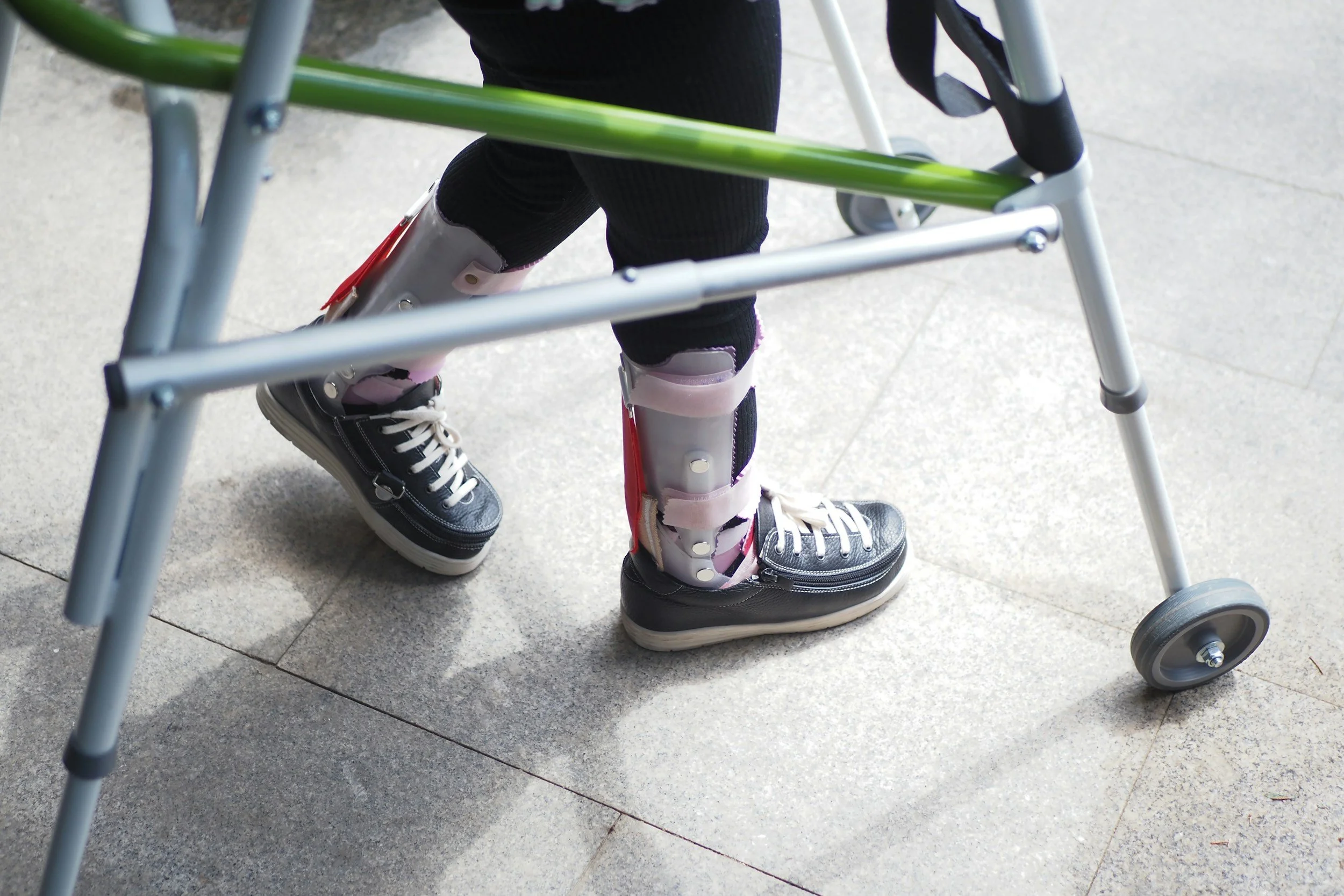
In-toeing and out-toeing are very common in children. A child’s feet may turn in or out because of the position of their feet, lower legs or hips. Muscle weakness, stiffness or restricted movement can also influence how a child controls their legs and feet during walking and running. These alignment patterns often change as children grow, and most children do not need treatment. However, significant asymmetry, pain, frequent tripping, difficulty participating in activities, or a pattern that is worsening rather than improving should be assessed by a paediatric physiotherapist or other healthcare professional. The important thing is not simply whether your child’s feet turn in or out, but why they are turning in or out and whether it is affecting your child’s movement or function.
What is in-toeing?
In-toeing, sometimes called “pigeon-toeing” is when a child’s feet point inwards when they walk or run.
What causes in-toeing?
The foot: The front of the foot may curve inwards, known as metatarsus adductus. This is more common in babies and young children. Metatarsus adductus responds well to stretching.
Inwards rotation of the shin bone: The shin bone (tibia) may naturally have some inward rotation, known as internal tibial torsion. This can cause the feet to point inwards when walking.
Inwards rotation of the thigh bone: The thigh bone (femur) may have increased inwards rotation, known as femoral anteversion. This can cause the knees and feet to turn inwards, particularly when walking or running.
Muscle strength and control: Reduced strength or control around the hips can make it harder for a child to control the position of their legs during movement. This may contribute to the appearance of in-toeing, particularly when running, jumping or with onset of fatigue.
Muscle or joint restriction: Tight calves and inner hip rotators can influence how a child positions their lower limb and may contribute to the foot turning in during movement.
A child can have one or a combination of these factors contributing to their in-toeing.
What is out-toeing?
Out-toeing is when a child’s feet point outwards when they walk or run. You may have heard this referred to as being ‘duck footed’.
What causes out-toeing?
Outwards rotation of the shin bone: The shin bone (tibia) may naturally have some outward rotation, known as external tibial torsion. This can cause the feet to point outwards when walking or running.
Outwards rotation of the thigh bone: The thigh bone (femur) may have increased outward rotation, known as femoral retroversion. This can cause the legs and feet to turn outwards, particularly when running and walking.
Muscle strength and control: Reduced strength or motor control around the hips and trunk can make it more difficult for a child to control the position of their legs during movement. Some children may also naturally turn their feet outwards to create a wider and more stable base of support.
Foot position: Differences in foot posture, including flat feet (pronation), can influence the position of the lower limb and may contribute to the appearance of out-toeing in some children.
Out-toeing is relatively common in young children who are learning to walk and, in many cases, improves as they grow.
When should you be concerned?
Most children with in-toeing or out-toeing do not need treatment. However, an assessment is recommended if you notice:
Pain in the hips, knees, legs or feet
Frequent tripping or falling, particularly if it is affecting participation in school, sport or play
One leg or foot turning significantly more than the other
A walking pattern that is getting worse rather than improving
Significant difficulty running, jumping or keeping up with other children
A sudden change in the way your child walks
A child who develops out-toeing alongside hip, thigh or knee pain
A foot that appears stiff or difficult to move
Noticeable weakness, fatigue or difficulty controlling the legs during activity
Persistent tightness or restricted movement at the hips, knees, ankles or feet
Concerns that the child’s walking pattern is affecting their confidence or ability to participate in activities
If your child is experiencing one or a combination of the above symptoms, we strongly advocate for an assessment by a paediatric physiotherapist.
What does an assessment involve?
When assessing in-toeing or out-toeing, we look at the whole lower limb rather that just the position of the feet. This includes:
Gait and movement assessment: We watch how your child walks, runs, jumps and moves during play.
Hip movement: We assess the amount of internal and external rotation available at the hips.
Knee and lower-leg alignment: We look at the position and rotation of the lower leg and how the knee moves during functional activities.
Foot posture: We assess the structure and movement of the feet to determine whether the foot itself is contributing to the child’s walking pattern.
Muscle strength: We assess whether weakness around the hips, knees, ankles or trunk is contributing to difficulty controlling the lower limb.
Muscle length and joint mobility: We look for tightness or restrictions around the hip and ankle that may influence how the child positions their legs and feet.
Balance and coordination: We look at how well your child can control their legs during walking, running, jumping and other activities.
Motor control and endurance: We assess whether alignment changes when your child is tired, moving quickly or completing more challenging tasks.
Functional impact: Most importantly, we consider whether the child’s alignment is actually affecting their ability to participate in everyday activities.
A thorough assessment helps us determine whether your child’s movement is simply part of normal development or whether they would benefit from intervention or further medical assessment.
Can exercises fix in-toeing or out-toeing?
This is a common question from parents. In many cases, exercises cannot change the underlying rotational alignment of the bones. For example, exercises cannot simply rotate a child’s thigh bone or shin bone into a new position. However, exercises may be recommended when there are associated issues such as reduced strength, poor balance, reduced motor control, muscle tightness or restricted movement. Exercises may help a child improve:
Hip, knee, ankle or trunk strength
Control of the legs during walking, running and jumping
Flexibility where muscle tightness is contributing to movement difficulty
In-toeing and out-toeing are common in children and often form part of normal growth and development. The position of the feet, shin bones and thigh bones can all influence how a child walks and runs. These alignment patterns often change as children grow.
While exercises cannot change the underlying shape or rotation of the bones, physiotherapy can help identify whether factors such as muscle weakness, stiffness, reduced motor control or reduced balance are contributing to your child’s movement difficulties.
If you have concerns about your child’s walking or running pattern, don’t hesitate to reach out and book an assessment with one of our paediatric physiotherapists. We can help determine whether any intervention is needed and provide guidance on how best to support your child’s movement and development.
-
Yes, both are very common and often part of normal growth. Many children's feet turn in or out in the early years and gradually improve on their own. The key question is whether it's affecting your child's movement, causing pain, or getting worse over time — if so, it's worth getting assessed.
-
Both can be caused by the natural rotation of the thigh or shin bones, foot position, or muscle weakness and tightness. Often it's a combination of factors rather than one single cause, which is why a full lower limb assessment is more useful than just looking at the feet.
-
It's worth booking an assessment if your child has pain in their hips, knees, legs or feet, trips or falls frequently, has one foot turning significantly more than the other, or if the pattern is getting worse rather than improving with age. A sudden change in the way your child walks is also a reason to seek advice.
-
In many cases, exercises can't change the underlying rotation of the bones. However, physiotherapy can help address contributing factors like muscle weakness, poor balance, tightness, or reduced motor control — all of which can make a real difference to how your child moves and feels during activity.